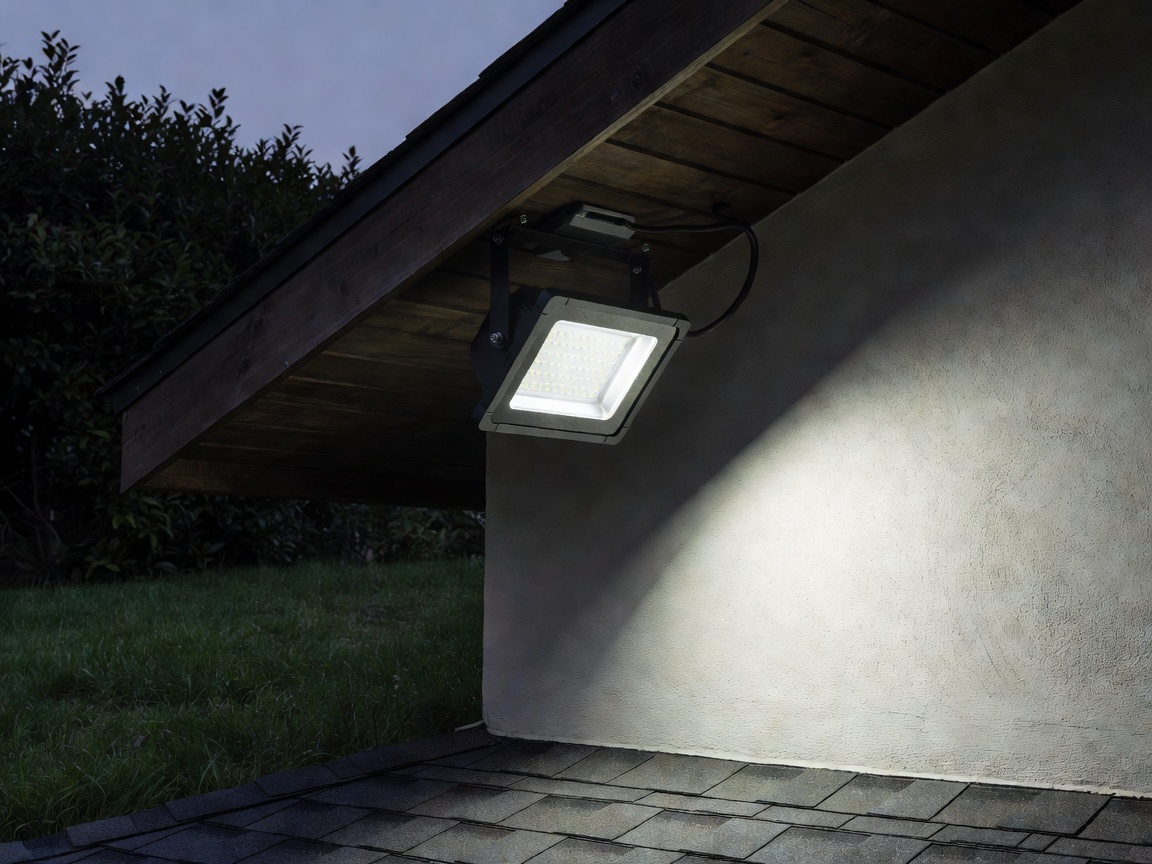
Security lighting serves a distinct psychological and physical purpose. Unlike pathway or ambient deck lighting designed to create warmth, a floodlight is an active deterrent and an operational aid for security cameras. Upgrading to smart security floodlighting shifts this category from a simplistic reactionary tool to a proactive, network-integrated security asset.
Lumen Output and Coverage Area
The primary metric of a floodlight is raw output. Traditional halogen security lights often consumed over 100 watts of power to produce sufficient illumination. Modern smart LED units drastically reduce thermal output and power consumption while increasing total lumens.
For standard residential driveways and backyard perimeters, fixtures rated between 2,000 and 3,000 lumens are generally recommended. Going beyond 3,500 lumens in close-quarters suburban environments frequently results in severe light pollution and neighbor disputes. The advantage of a smart floodlight is variable dimming; you can run a 3,000-lumen fixture at a passive 10% brightness to mimic moonlight, reserving the blinding 100% capacity strictly for active motion events.
Sensors and Vision Integrations
There are two distinct hardware paths when selecting smart floodlights: standalone fixtures with onboard motion sensors, and hybrid camera-floodlight combinations.
- Standalone Smart Floodlights: These feature advanced passive infrared (PIR) sensors with customizable detection zones. Users can draw digital boundaries within their companion apps, instructing the light to ignore passing street traffic but trigger immediately if a heat signature crosses the property line.
- Hybrid Camera Floodlights: Integrating a 1080p or 4K sensor directly into the fixture chassis allows for visual verification of triggers. More importantly, these units utilize the camera's visual processing capabilities (often powered by edge-AI) to differentiate between animals, swaying branches, and human figures, significantly reducing false positive illuminations.
Installation and Power Requirements
Due to the high energy draw of bright LED arrays and integrated cameras, battery-operated floodlights are rarely viable for long-term, high-traffic use. They require frequent recharging and often throttle brightness to preserve battery life. Therefore, hardwired installation is strongly advised.
Smart floodlights usually mount to standard circular exterior junction boxes. Replacing an existing dumb floodlight is often a straightforward wire-to-wire swap. However, because these devices must maintain a constant connection to the home network, ensuring robust 2.4GHz Wi-Fi penetration through exterior walls at the mounting location is critical. If signal strength is poor, adding an exterior-rated mesh node or Wi-Fi extender may be necessary prior to installation.
Advanced Home Automation Routines
The true value of a smart floodlight is unlocked when integrated with broader home automation platforms. A floodlight detecting motion can be the trigger event for a cascade of security actions.
For example, a routine can be programmed so that if the rear floodlight detects a person between midnight and 5:00 AM, the system simultaneously illuminates all interior hallway lights to 30%, activates exterior pathway lights, and sends a silent push notification to the homeowner's phone. This interconnected ecosystem approach creates an active illusion of occupancy, which is widely recognized as one of the most effective deterrents against property intrusion.