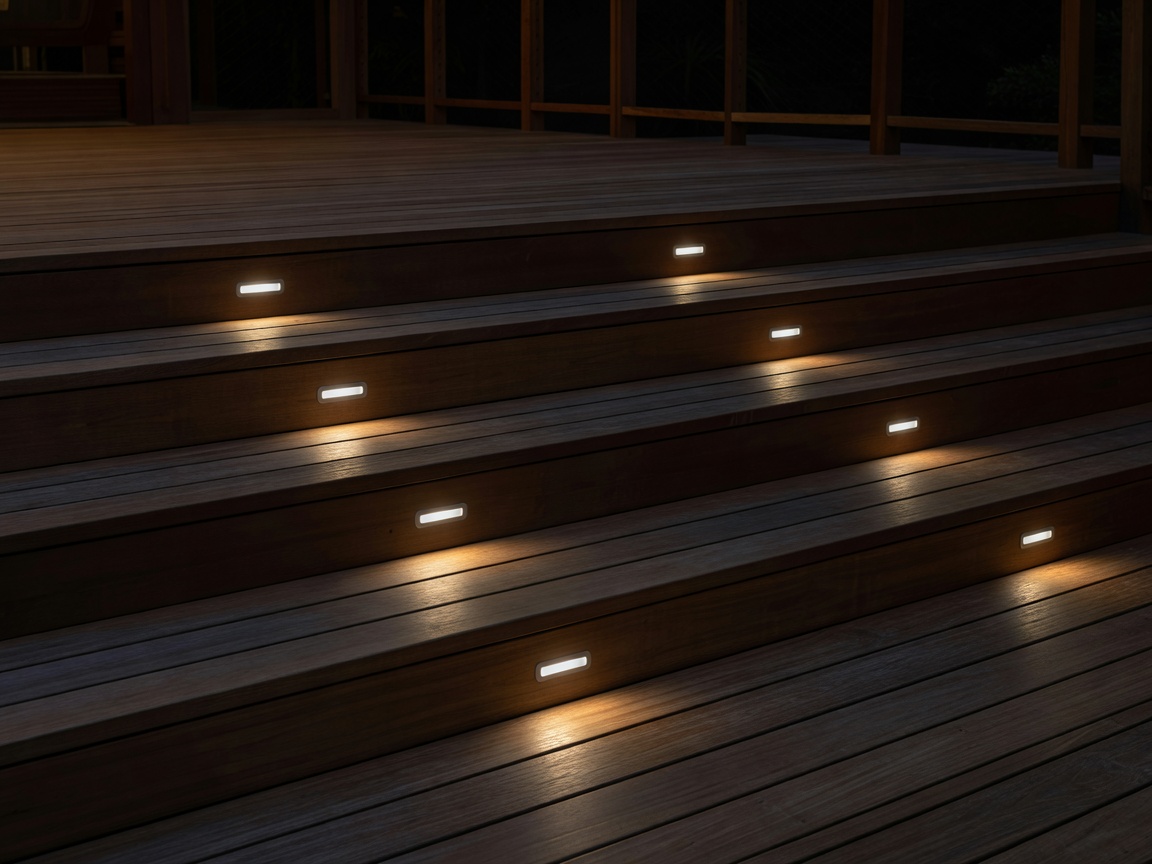
Elevation changes are the highest liability areas of any exterior living space. Navigating dark stairs or unexpected deck drop-offs invites injury. Installing smart lighting directly into deck framing and stair risers provides critical visual cues while keeping the light source hidden, reducing blinding glare.
Installation and Glare Reduction
Unlike pathway or string lights, deck and step lights are usually permanent architectural modifications. They require boring holes into wood or composite decking and fishing low-voltage cables behind the fascia boards. Because of the labor involved, investing in high-quality, sealed smart fixtures is highly recommended to avoid premature failure and replacement.
The primary design challenge with step lighting is glare. If a light is mounted too high on a stair riser, or if the lens is completely flat, ascending the stairs positions the walker's eye directly in the path of the LED diode. To combat this, quality fixtures utilize louvered faceplates or deep cowls that direct light exclusively downward onto the tread below. When combined with smart dimming capabilities, you can tune the output to the exact threshold where the tread is visible but the light source is practically invisible from above.
Zone Grouping and Transformations
A smart deck lighting layout shines brightest when fixtures are grouped into functional zones. Rather than treating the entire deck as a single switch, a smart controller can manage different areas independently.
Consider a multi-level deck scenario:
- The Perimeter Zone: Recessed lights along the outer rim joist facing the yard. This can be left at a steady 20% brightness to outline the structure visually from the lawn.
- The Stair Zone: Dedicated riser lights. These can be tied to a motion sensor at the top and bottom of the stairs, gently ramping up to 80% brightness when foot traffic is detected.
- The Seating Zone: Post-cap lights near the seating area. These can be adjusted for color temperature and brightness based on the activity—bright and cool for cleaning, warm and dim for conversation.
Powering the Array
Almost all deck and step lights operate on low-voltage DC power (typically 12V). This requires a transformer to step down the standard 120V household current. When designing a smart system, you must decide where the "brains" live. You can use standard "dumb" LED fixtures connected to a central smart transformer (which controls the whole group), or use addressable smart fixtures connected to a standard transformer (allowing individual color and brightness control for every single light).
For complex architectural layouts, the individually addressable route offers far more flexibility, allowing a homeowner to create intricate chasing patterns or subtle gradients across the deck's surface.