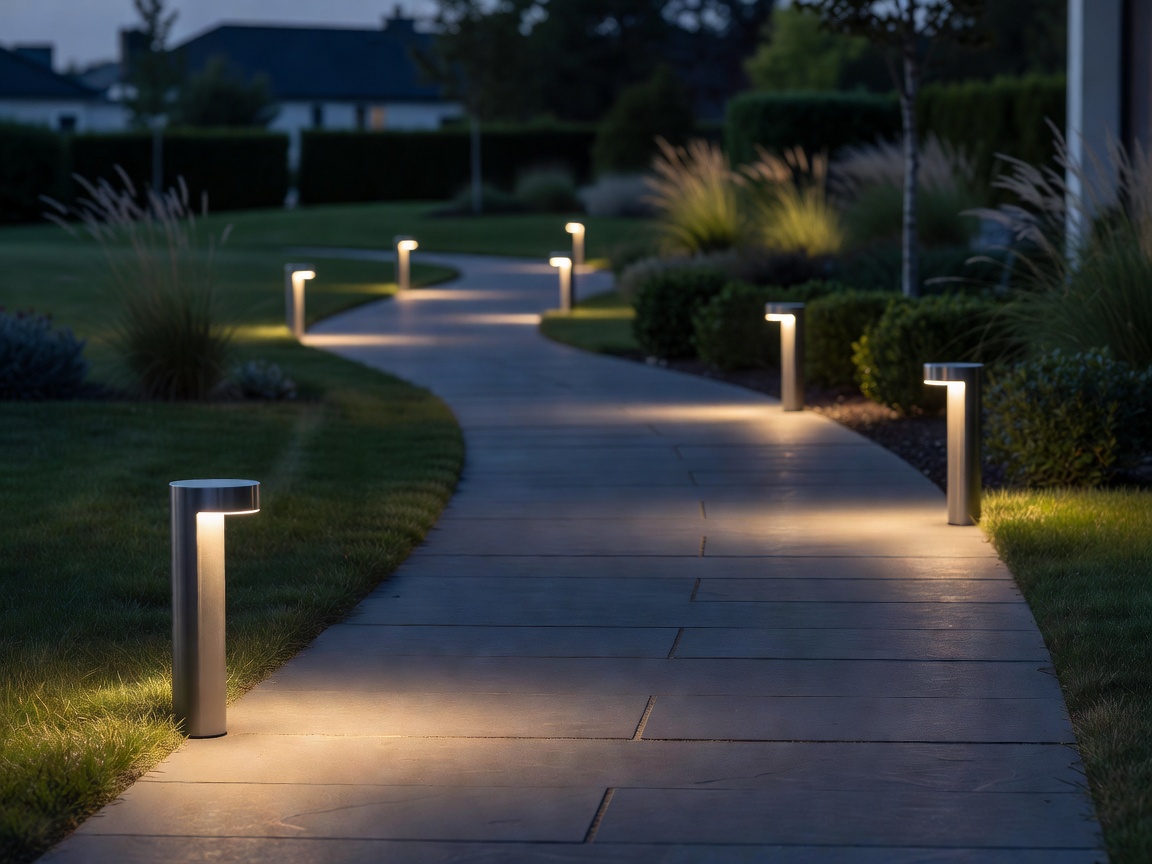
Pathway lighting is arguably the most critical component of a functional exterior lighting plan. It serves dual purposes: guiding foot traffic safely during twilight hours and defining the architectural flow of your landscaping. When transforming this necessity into a "smart" ecosystem, several technological and physical layout considerations must be addressed.
Power Infrastructure: Solar vs. Low-Voltage
The first decision when integrating smart pathway lights is determining the power source. The market generally splits into independent solar-powered units and integrated low-voltage (usually 12V or 15V) wired systems.
Solar-Powered Smart Systems have vastly improved in recent years. High-efficiency photovoltaic panels paired with lithium-ion batteries allow for self-contained operation. The primary benefit is absolute freedom of placement without trenching cables. However, from a smart integration perspective, independent solar lights often rely on Bluetooth (which limits range and necessitates bridge devices) or proprietary RF networks. Furthermore, their performance is inherently tied to weather conditions; a string of heavily overcast days will degrade operational uptime.
Low-Voltage Wired Systems are the industry standard for robust, reliable smart lighting. These systems connect to a centralized transformer plugged into a standard exterior outlet. Smart functionality is injected either at the transformer level (creating a single smart zone) or within the individual fixtures themselves (allowing addressable, multi-zone control along a single wire run). While installation requires running direct burial cable, the constant power supply enables the use of robust mesh networking protocols like Zigbee or Thread without rapid battery drain.
Spacing and Layout Geometry
The most common mistake in pathway lighting is creating what landscape architects refer to as the "airport runway effect." This occurs when lights are placed directly across from each other in rigid, tight linear patterns. To avoid this and create a welcoming environment, professionals recommend a staggered, alternating layout.
When calculating spacing for smart path lights, consider the lumen output and beam spread of your chosen fixtures. Most modern LED smart fixtures output between 100 to 300 lumens per unit. At a standard height of 18 to 24 inches above grade, a 200-lumen fixture generally casts a useable pool of light measuring 6 to 8 feet in diameter. Therefore, spacing fixtures every 8 to 10 feet, alternating on opposite sides of the path, provides gentle, overlapping pools of illumination without overwhelming the eye.
Networking and Connectivity Constraints
Outdoor connectivity presents unique challenges not found inside the home. Exterior walls made of brick, stone, or stucco are notorious for degrading 2.4GHz Wi-Fi signals. Relying purely on Wi-Fi fixtures for the edges of a property often results in erratic performance and dropped connections.
The solution is adopting mesh networking standards. Zigbee and Thread are particularly well-suited for outdoor pathway lighting. In these protocols, every wired, constantly-powered light acts as a repeater node. As long as the first fixture is within range of the interior bridge or smart home hub, the signal daisy-chains down the pathway. This allows a network of lights to extend hundreds of feet away from the main structure, far beyond the reach of standard router signals.
Automation Strategy
True intelligence in pathway lighting is realized through automation. Basic time-based scheduling has been replaced by dynamic astronomical timers. Modern smart platforms calculate local sunset and sunrise daily based on GPS coordinates. A common and highly effective routine is to trigger the pathway lights to illuminate at 40% brightness 15 minutes before sunset, creating a subtle transition into evening.
Integration with exterior motion sensors adds another layer of utility. While keeping the baseline brightness low saves energy and reduces light pollution, a passive infrared (PIR) sensor positioned near a driveway or gate can command the pathway network to ramp up to 100% brightness instantly when a vehicle or person enters the property, ensuring safe navigation.